
Mental Accounting and Herd behavior
Chapter Two - Part 4
Author: Rich Porlé
9/13/20258 min read


Mental Accounting: How We Fool Ourselves with Money
Imagine you found 5,000 pesos on the street today. Would you treat it the same way as the 5,000 you earned from your last freelance job or paycheck? Most people would not. Even though the money is worth the same, the way we feel about it and how we choose to use it often changes depending on where it came from. This is the core idea behind Mental Accounting. It is a concept from behavioral finance that explains how we mentally categorize and treat money differently, even when logic says we should treat all money the same.
The truth is: money is money. It is completely fungible, meaning every peso has the same value no matter where it comes from. But our brains don’t see it that way. Instead, we divide money into separate mental “accounts” based on where it came from, what it’s meant for, or how we plan to use it. This mental habit can help us stay organized, but it can also lead to irrational decisions, missed opportunities, and financial mistakes especially in trading and investing.
What Is Mental Accounting?
Mental Accounting is the tendency for people to assign different values to money depending on its origin, purpose, or intended use, instead of treating all money equally. This concept was introduced by Richard Thaler, a pioneer of behavioral economics and Nobel Prize winner. Thaler showed that people often make financial decisions that go against traditional economic theory, not because they are careless, but because of how they frame their money in their minds.
We do not just have one mental wallet. We have many. Even if all of these are technically “our money,” we behave as if each category follows different rules.
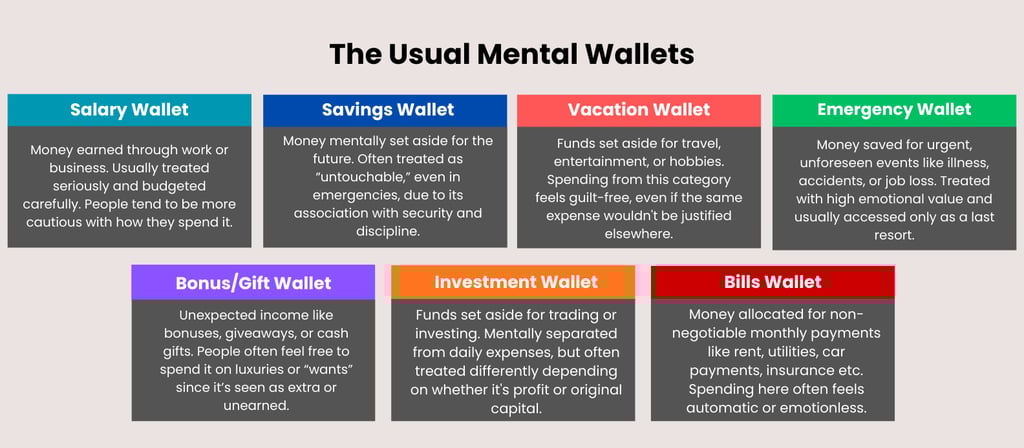
Mental Accounting in Everyday Life
Let me share a moment that taught me a valuable lesson. A few years ago, I made a decent profit from my forex trading around 53,000 pesos. It was not a life-changing amount, but it felt like a reward. In my mind, I labeled it as bonus money, something extra I could enjoy without guilt. So, I bought new tennis gears, went on short trips, and treated myself to a few nice dinners. I didn’t plan, and I didn’t think twice. Then, just a few weeks later, my car insurance and maintenance were due totaling 51,000 pesos. That was the moment reality hit me. I had the money, but I had already spent it on things I convinced myself were from a separate “budget.” In my head, tennis and fun were in one mental account, and car expenses were in another. That was the first time I clearly saw how my emotions had overruled my logic. I had allowed mental accounting to make the decision for me. Looking back, that experience reminded me that how we label our money matters far less than how we use it. Every peso count, and the story we attach to it can either help us grow or hold us back.
Mental accounting shows up in everyday life more often than we realize. For example, people tend to spend “found” money like lottery winnings, tax refunds, 13th month pay or birthday cash more freely than their regular paycheck, even if the amounts are the same. Others separate income and savings too strictly, refusing to touch their savings even when burdened by high-interest credit card debt, simply because they’ve labeled it “untouchable.” In trading, many treat profits like gambling chips, taking bigger risks with money they see as “extra,” even though it’s just as real as their initial capital. And when it comes to spending, research shows that people part with more when using credit cards than cash, since cash feels more tangible and immediate.
Mental Account in Trading
In trading and finance, mental accounting often influences the way we think about money, and if left unchecked, it can quietly lead us to costly mistakes. Many traders take bigger risks with their profits, seeing them as extra money rather than part of their capital, which fuels overconfidence and reckless decisions. Others hold on to losing positions for too long because they have already pictured those funds as future profits, letting emotions overshadow discipline and sound judgment. Investors may also separate their portfolios into safe and risky portions without considering the overall balance, which creates a false sense of security while exposing them to unnecessary risk. The reality is simple: the market does not care where your money came from, and every peso gained or lost is part of the same financial reality. We fall into this trap because the human brain naturally organizes money into categories, making us feel in control and giving us a sense of progress toward different goals. While this mental habit can sometimes help us, it becomes dangerous when it turns rigid or emotional, preventing us from seeing the bigger picture. The key to overcoming this bias is to treat all money as equal, create real budgets instead of mental ones, and always think about the opportunity cost of every decision. It also helps to combine goals based on timeframes rather than emotions, and most importantly, to remember that profits are not free money but part of your capital. When you respect your profits the same way you respect your initial investment, you bring discipline, clarity, and wisdom into your financial journey.
Understanding Herd Behavior: The Power and Peril of Following the Crowd
In my own journey as a trader and a financial market professional, I have seen firsthand how easy it is to get caught up in herd behavior. It is that natural pull to follow what everyone else is doing, because moving with the crowd feels safe and comforting. But the truth is, some of the worst market crashes and bubbles I have witnessed were fueled by this very instinct. I remember times when I felt tempted to jump into a trade just because everyone around me was buying, only to realize later that the crowd was wrong and the losses were real. That experience taught me that understanding herd behavior is not just about knowing market psychology, but it is about protecting yourself from costly mistakes. By learning why it happens, how it shapes markets, and how to recognize when it is influencing your own decisions, you gain the strength to step back, trust your analysis, and make choices that align with your strategy instead of the noise around you.
What Is Herd Behavior?
Herd behavior refers to the phenomenon where individuals mimic the actions of a larger group, often ignoring their own information or analysis. Imagine standing in a crowd, unsure of what to do, and seeing everyone rushing in one direction. You might be tempted to follow them, believing they must know something you do not. This is the essence of herd behavior. In finance, this manifests when investors buy or sell assets simply because others are doing so, rather than because they have evaluated the fundamental value or risks. The fear of missing out, peer pressure, or the belief that “everyone cannot be wrong” drives this behavior.
Herd behavior is so common in trading and investing because of deep psychological forces that influence the way we make decisions under uncertainty. As social beings, we naturally seek comfort in numbers, so when we are unsure, we look to others for guidance and feel reassured that a choice is correct if many are doing the same. This creates a sense of safety, even when the decision itself is flawed. Fear of missing out adds another layer, pushing people to chase trends or investments simply because others seem to be profiting, often without careful analysis. Information cascades make the effect even stronger, as we assume that if enough people are buying or selling, they must know something we do not, even when no new facts exist. At the same time, following the crowd allows us to avoid responsibility, because if the outcome turns out badly, we feel less blame knowing we were not alone. The danger is that these instincts, while deeply human, often lead us away from rational choices and into bubbles, crashes, and missed opportunities. Recognizing these forces within ourselves is the first step to resisting them, and true growth comes when we learn to trust our own judgment, act with discipline, and rise above the noise of the crowd.
How Herd Behavior Shapes Markets
Herd behavior can lead to extreme market movements that do not reflect the true value of assets. I have seen firsthand how herd behavior shapes markets and drives prices in ways that have little to do with real value.
1. Market Bubbles
Bubbles occur when the price of an asset inflates far beyond its intrinsic value because investors collectively rush to buy. The dot-com bubble in the late 1990s and the housing bubble before the 2008 financial crisis are classic examples. Investors bought tech stocks or real estate not because of fundamental analysis but because others were doing so. The rising prices attracted even more buyers in a self-reinforcing cycle.
2. Market Crashes
Just as herd behavior can inflate prices, it can also cause sudden crashes. When confidence evaporates, investors rush to sell simultaneously. Panic spreads quickly because everyone is watching each other, and fear multiplies. The 2008 financial crisis featured dramatic sell-offs fueled by herd behavior.
George Soros, a Hungarian American investor and philanthropist, once said, “Stock market bubbles do not grow out of thin air. They have a solid basis in reality, but reality as distorted by a misconception.” What he meant is that bubbles never come from nothing; they often begin with a real and valid idea, such as the belief that new technology will transform industries or that housing is a safe long term investment. There is truth in these ideas, but the danger begins when people exaggerate or misinterpret that truth. Excitement, speculation, and herd behavior distort reality, and instead of carefully assessing opportunities, investors overinflate their importance and convince themselves that prices will continue to rise without limit. In simple terms, Soros reminds us that bubbles are rooted in something real, but human emotions and misconceptions twist that reality until prices drift far away from actual value.
How to Recognize Herd Behavior & Resist it
Recognizing when herd behavior is shaping your decisions or influencing the market is the first step to avoiding costly mistakes. Rapid price increases with little to no supporting news often signal the early stages of a bubble. Sudden waves of excitement or panic on social media or in headlines are also red flags that herd mentality may be taking over. If you ever feel pressured to act quickly simply because “everyone else is doing it,” that is the moment to pause and ask yourself whether your choice is based on sound information or just a fear of missing out or standing alone.
To resist the pull of the herd, it is important to stay grounded in a disciplined approach. Start by doing your own research and focus on fundamentals such as company performance, market conditions, and long-term trends instead of being swayed by popular opinions. Develop a clear plan that defines your goals, risk tolerance, and strategies so that when the market turns emotional, you have a framework to guide your actions. Question popular opinions with healthy skepticism, and remember that being widely accepted does not make an idea correct. Control your emotions by recognizing how fear and greed can cloud judgment, and protect yourself with risk management tools such as stop loss orders. Diversify your portfolio so that no single market swing driven by herd behavior can do excessive damage.
Following the herd feels natural because it is deeply rooted in human psychology. From early human history, survival often depended on the safety of sticking with the group. Even today, that instinct lingers and influences how we behave in markets. Understanding this tendency allows us to be more forgiving when we make mistakes while also reminding us that success in trading and investing often comes from breaking away from the crowd. True progress happens when we rely on research, discipline, and independent thinking rather than on the comfort of doing what everyone else is doing.
Address
27th Floor, The Podium, Lower Ortigas Center, Mandaluyong City, 1605 Metro Manila, Philippines
Contacts
Whatsapp: +639916728173
Email: join@richlifeacademia.com


RichLife Academia operates as the digital learning of the Philippine Learning Edge Services Inc.
© 2026 RichLife Academia. All rights reserved.